.svg)

Fact Sheet
The Terawatt-Hour Opportunity: Energy Storage on the U.S. Power Grid & the Pathway to an Affordable Energy Future - One-Pager
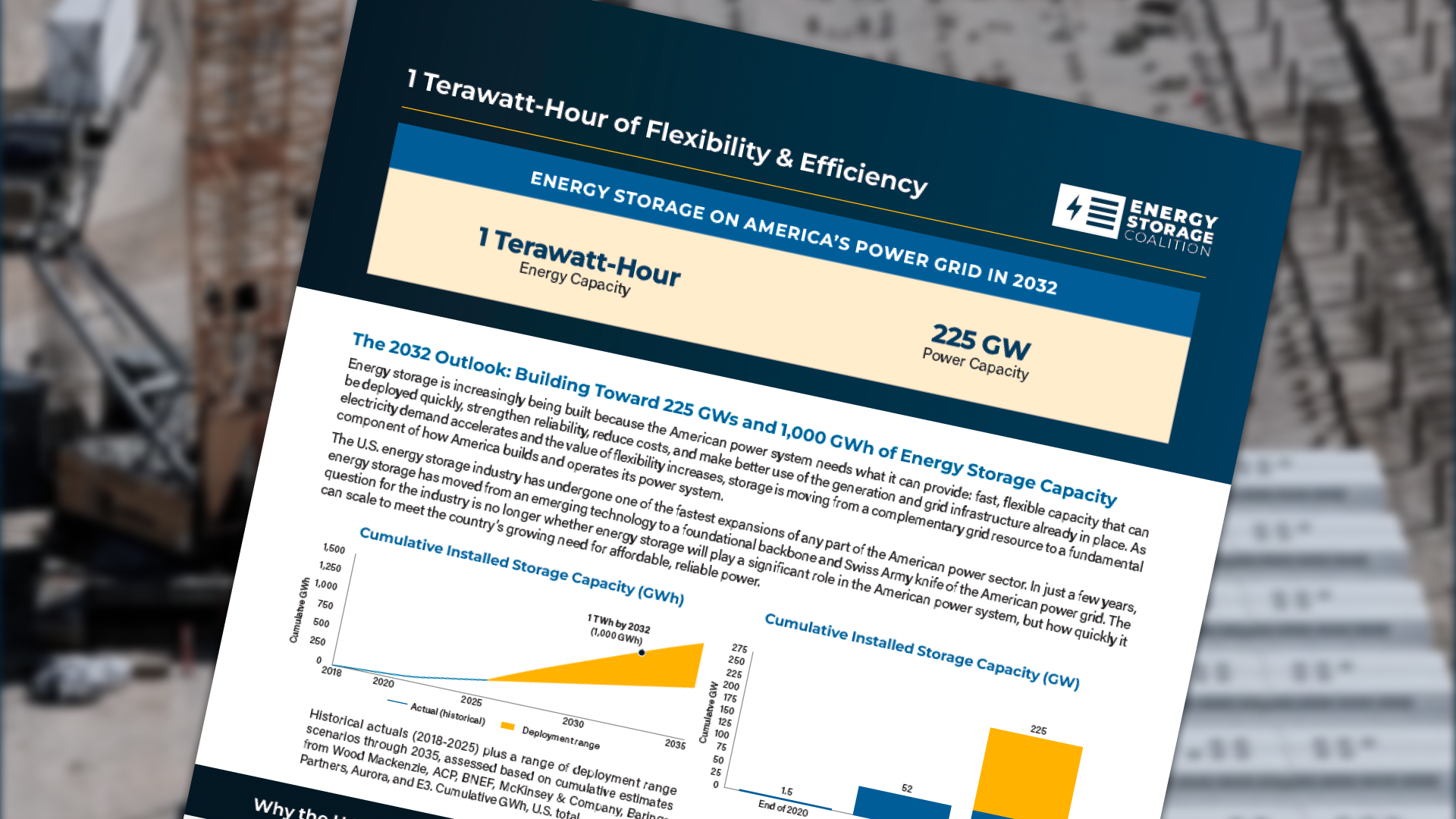
An ESC analysis published in September 2026 found that energy storage offers the speed to power, reliability and flexibility to confront America’s energy demand challenge while fortifying energy security, if policy and regulatory frameworks enable the industry to scale at the pace the U.S. power system demands.
Key Highlights:
The energy storage industry is targeting 225 gigawatts / 1 terawatt-hour of storage deployment by the end of 2032.
- Reaching 1 TWh over the next 5 years requires a 25% annual growth rate (CAGR).
- Overall, represents more than 300% in power capacity and 500% in energy capacity for energy storage resources over the next 5 years.
- Energy storage capacity will reach more than 20% of current U.S. peak electricity demand.
- Energy storage resources operating in all 50 states.
- 225 GW of energy storage capacity is equivalent to peak power supply for Texas, California, Florida, and Michigan combined.
Energy storage will generate more than $250 billion in cost savings over the next decade by scaling deployment to 850+ GWh.
- The cumulative energy system cost savings averages out to $1,550 across all 160 million American ratepayers.
- Energy storage delivers cost savings by efficiently boosting grid utilization, avoiding more expensive or unnecessary infrastructure upgrades, lowering peak pricing, and getting more out of the power generation resources we already have on the grid.
- Texas as a case study: emblematic of the dual benefits storage can deliver to boost reliability and lower costs — $1.5 billion in savings over Summer and Winter extreme weather events in 2024, and a reduction of grid emergencies from 13 to in 2023 to zero in 2025.



Energy Storage is