.svg)

Energy Storage is Critical to Powering America's AI Data Centers
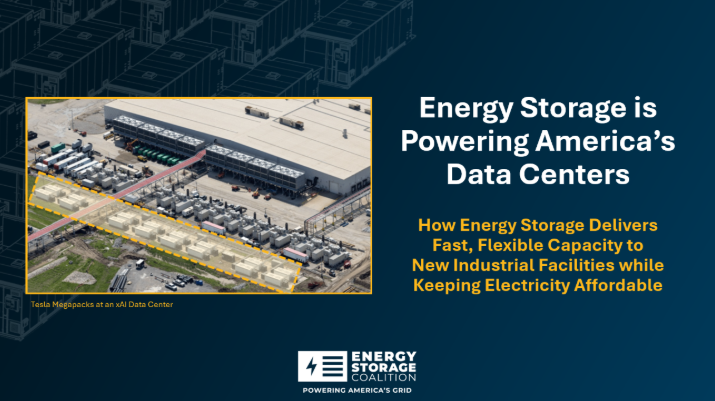
The United States is experiencing the fastest growth in electricity demand in decades, driven largely by new data centers, AI supercomputing clusters, advanced manufacturing, and industrial reshoring. These facilities require enormous volumes of highly reliable power, often located in regions where the grid is already strained and transmission expansion or large plant construction timelines can take years longer than it takes to build an industrial facility.
To support this growth, the grid needs resources that can be deployed quickly, deliver flexibility, and ensure power and price stability. A Duke University study details how just a few hours of daily or weekly flexibility can unlock more than 100 gigawatts of hidden grid capacity. There are various ways to achieve this flexibility, but energy storage will be a critical solution for delivering the flexibility and power America needs to win the AI race.
Here are four reasons why energy storage will be essential for delivering American AI Dominance:
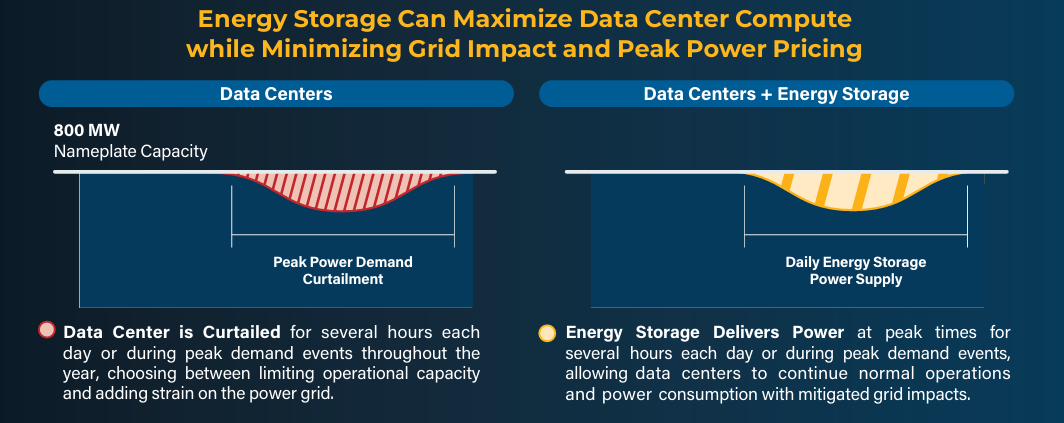
1. Energy Storage Makes New Large Loads Flexible Without Compromising Computational Operations: Modern data centers can elect to change their operations to based. Energy storage enables these large facilities to operate as flexible load—charging when power is abundant and discharging when the grid is stressed. This means an 800 MW data center can effectively behave like a 600 MW load during peak hours without reducing computing performance or disrupting operations. That flexibility reduces interconnection impacts, protects reliability, and speeds deployment of critical digital infrastructure.
2. Energy Storage Delivers New Power Capacity Very Quickly: While upgrading transmission networks or building new large power plants can take 5–10 years, grid-scale batteries can be deployed and connected to the grid in just months. Energy storage adds firm, dispatchable capacity faster than any other resource, enabling utilities, regional grid operators, and state regulators to integrate new industrial and AI facilities under their accelerated timelines.
Aligned, a data center provider, partnered with Calibrant Energy to accelerate speed to power on one of its facilities, providing a short-cut to a process that could've otherwise taken years.
Calibrant, a provider of on-site energy solutions for large power users, will deliver a 31 MW / 62 MWh battery energy storage system (BESS) at Aligned’s data center campus. The on-site system, planned to be operational in 2026, will enable the facility to come online and scale operations years earlier than would be possible with traditional utility upgrades. (Aligned)
At another operating AI data center, Tesla Megapack energy storage systems were added to the campus in less than one year, allowing the facility to quickly ramp up its operations.
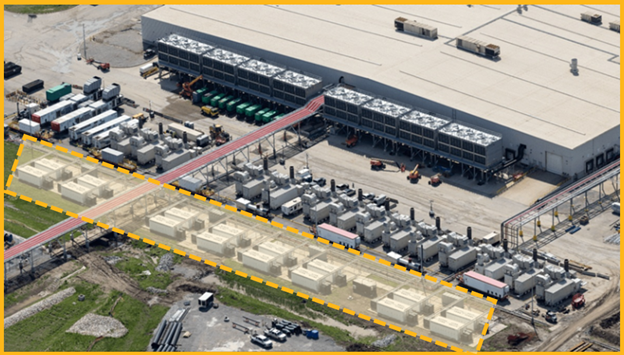
View full size image: Tesla Megapacks at the xAI Colossus Supercomputer
3. Energy Storage Maximizes Existing Generation and Keeps Electricity Affordable for All Customers: Batteries stretch existing generation by discharging during peak pricing periods, reducing the need for expensive short-term transmission upgrades and ensuring that baseload plants—coal, gas, and nuclear—operate more efficiently. By shifting energy to hours of highest demand, storage lowers market volatility, improves grid economics, and delivers more megawatts from the capacity we already have.
In Michigan, utility DTE is planning to power a new hyperscale data center through multiple energy storage facilities, maximizing existing generation resources and expanding its peak capacity by more than 25%. The arrangement between the utility and the data center allows for the energy storage resources to be used to provide services to the broader grid, including providing excess power to other customers, to promote electricity affordability. (Utility Dive)
In Indiana, the utility Northern Indiana Public Service Co. (NIPSCO) will deploy energy storage to support and enhance baseload resources to power Amazon data centers.
NIPSCO, a NiSource subsidiary, expects its 15-year deal with Amazon will produce about $1 billion in savings for its ratepayers. Those savings will be reflected as a credit on customers’ electric bills, according to a Nov. 7 filing by NIPSCO and NIPSCO Generation at the IURC. (Utility Dive)
4) Energy Storage Provides All Kinds of Power Services to Large Industrial Facilities, including Back Up Power and Power Quality or Stability Services: Energy storage supports uninterruptible power supply (UPS) resilience, protects power quality, and enables continuous operations when the facility might otherwise lose power. For facilities where downtime can cost millions per minute or present a security risk — energy storage provides instant response and high-reliability backup that strengthens mission-critical operations.
The Bottom Line: Energy Storage is a Key Solution for Delivering Fast, Affordable Power to New American Data Centers and Factories
Energy storage can help American quickly deploy and power new data centers and win the AI race. By supporting baseload resources and directly adding grid capacity and flexibility, data centers can be added more quickly, at a lower cost, and without compromising critical compute operations.
If the U.S. is going to lead the world in artificial intelligence, continue its manufacturing resurgence, and achieve our energy dominance ambitions, we must continue to deploy storage at unprecedented speed and scale.
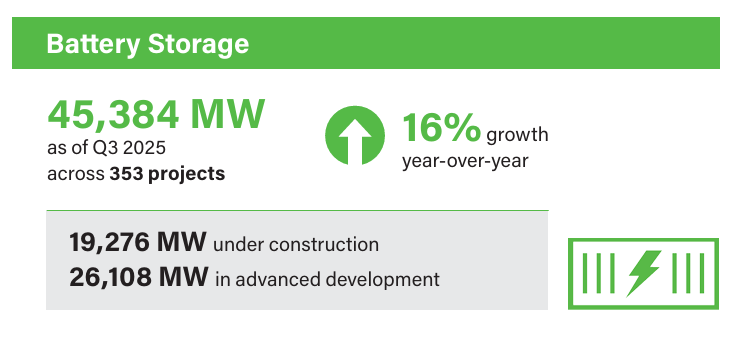
View full size image: Energy Storage Project Pipeline - Data Courtesy the American Clean Power Association Q3 2025 Market Report